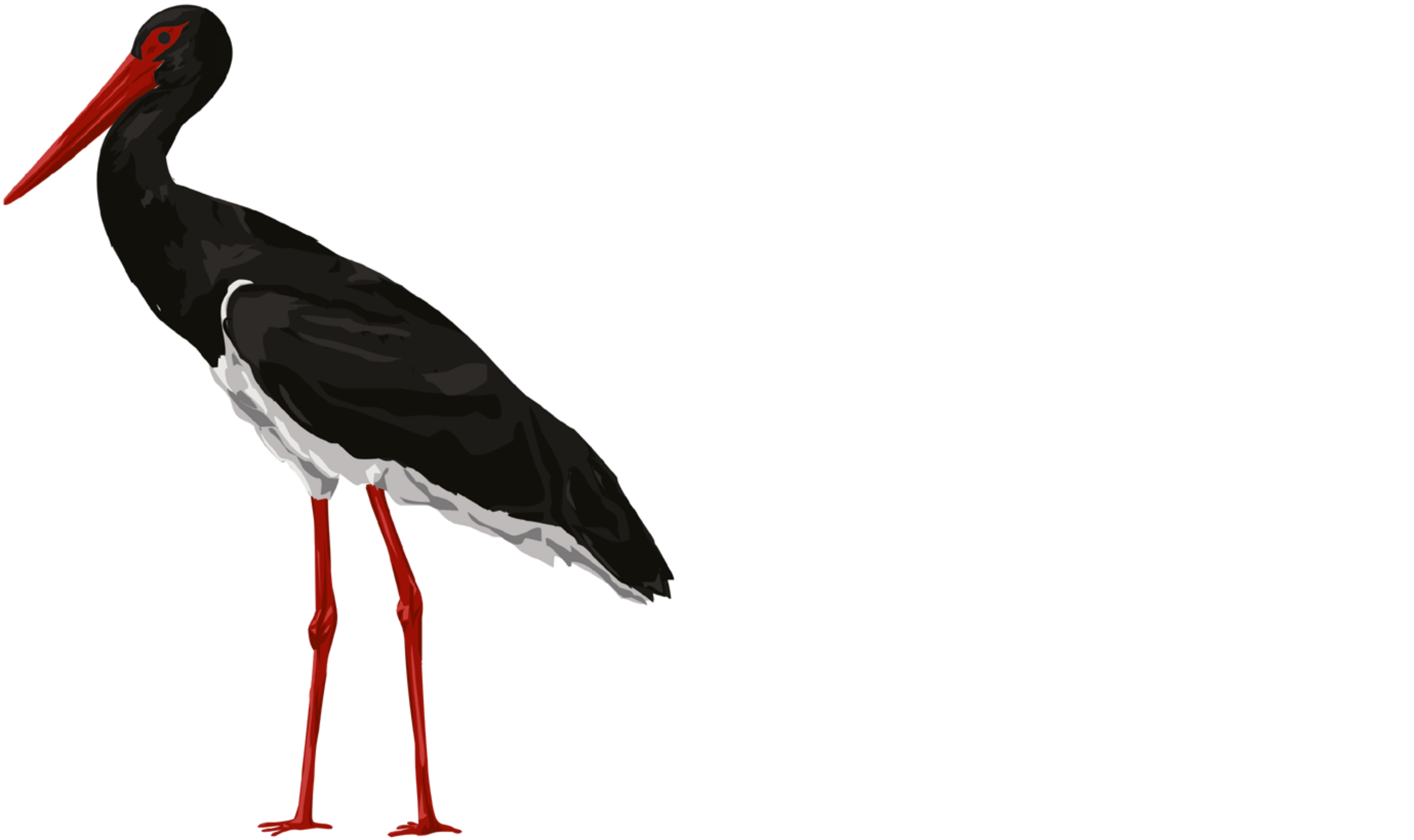
Literatura oraz prace naukowe związane z gatunkiem bocian czarny (Ciconia nigra)
Materiały polskojęzyczne:
- Adamiak W. 1973. Bocian czarny (Ciconia nigra) w powiecie Jarocin województwa poznańskiego. Zakład Ochrony Przyrody Polskiej Akademii Nauk (ISSN 0009-6172)
- Artemiuk A, Klich D. 2012. Charakterystyka gniazdowania bociana czarnego Ciconia nigra w Parku Krajobrazowym "Lasy Janowskie". Sylwan 156(3):225−232
- Bokotej A, Dziubenko N. 2012. Badania i ochrona bociana czarnego Ciconia nigra L. na Ukrainie. Roczniki Bieszczadzkie 20: 146-155
- Buczek T. Ciconia nigra (Bocian czarny) A030. Poradniki ochrony siedlisk i gatunków Natura 2000
- Cenian Z., Wręga S. (red.). 2023. Ochrona bociana czarnego Ciconia nigra. Komitet Ochrony Orłów, Biuletyn Nr 21/2023, Olsztyn
- Kaługa I. 2007. Aktywna ochrona bociana czarnego Ciconia nigra i jego siedlisk - Towarzystwo Przyrodnicze Bocian. Studia i Materiały Centrum Edukacji Przyrodniczo-Leśnej, R.9. Zeszyt 2/3 (16)/2007
- Matusiak J., Olszewski M, Różycki A. 2017. Wybiórczość środowiskowa miejsc lęgowych oraz typy umiejscowienia gniazd bociana czarnego Ciconia nigra w Kampinoskim Parku Narodowym. Studia i Materiały CEPL 19(2):169-185
- Pugacewicz E. 2015. Przebieg regresu białowieskiej populacji bociana czarnego Ciconia nigra w latach 1985-2014. Dubelt 6-7:67-92
- Stój M. 1996. Ptaki drapieżne i bocian czarny Ciconia nigra w Beskidzie Sądeckim. Chrońmy Przyr. Ojcz. 52(4):38-44
- Stój M. 1995. Ekologia rozrodu bociana czarnego Ciconia nigra w Beskidzie Niskim i okolicach Jasła. Chrońmy Przyr. Ojcz. 51(2):29-39
- Zawadzka D., Olech B., Zawadzki J. 1990. Zagęszczenie, rozród i pokarm bociana czarnego (Ciconia nigra) w Kampinoskim Parku Narodowym w latach 1979-1987. Notatki Ornitologiczne 31(1-4):5-20
- Zbyryt A. i in. 2013. Materiały do wyznaczania i określania stanu zachowania siedlisk ptasich w obszarach specjalnej ochrony ptaków Natura 2000. GDOŚ. Warszawa
- Zieliński P. i in. 2011. Czy ochrona strefowa miejsc gniazdowych bociana czarnego jest wystarczająca? Studia i Materiały CEPL 13(2):49-56
- Zieliński P. i in. 2017. Wzrost liczebności i zagęszczenie bociana czarnego Ciconia nigra w Polsce środkowej. Chrońmy Przyr. Ojcz. 73(2):101-109
- Zieliński P., Janic B., Kamiński M. 2017. Bezpieczne obrączkowanie piskląt bociana czarnego (Ciconia nigra). Studia i Materiały CEPL w Rogowie. R.19.Zeszyt 53/4/
- Zieliński P. i in. 2017. Wzrost liczebności i zagęszczenie bociana czarnego Ciconia nigra w Polsce środkowej. Chrońmy Przyrodę Ojczystą 73(2):101–109
Materiały z całego świata:
- Bobek M. et all. 2008. African Odyssey project – satellite tracking of black storks Ciconia nigra breeding at a migratory divide. Journal of Avian Biology 39: 500-506.
- Błoszyk J. et all. 2009. Nests of the black stork Ciconia nigra as a habitat for mesostigmatid mites (Acari: Mesostigmata). Biologia. 64 (5): 962–968.
- CANO ALONSO L.S. et all. 2006. The breeding population of Black Stork Ciconia nigra in the Iberian Peninsula. Biota 7/1-2.
- Chevallier D. et all. 2011.The use of stopover sites by Black Storks (Ciconia nigra) migrating between West Europe and West Africa as revealed by satellite telemetry. Journal of Ornithology. 152 (1): 1–13.
- Czuchnowski R., Profus P. 1996. The Black stork in Poland: Distribution, population changes and reproduction. International conference on the Black stork Abstracts: 35.
- Czuchnowski R., Kurowski M., Profus P. 1996. The population of the Black stork in Radom province, Poland (1981-1995). International conference on the Black stork Abstracts: 68.
- Czuchnowski R., Profus P. 2006. Situation des Schwarzstorchs Ciconia nigra in Polen. Caradrius 41. Heft 1-2.:75-78.
- Drobelis E. 1993. On the biology and protection of the black stork (Ciconia nigra L.) in Lithuania. Acta Ornitol. Lituanica 7-8:94-99.
- Finlayson C. 2010. Birds of the Strait of Gibraltar. London: Bloomsbury Publishing. ISBN 978-1408136942.
- Horban I, Bumar H. 2006. Conservation biology of Black Stork (Ciconia nigra) in Ukrainian Polyssia. Biota 7, 1-2: 37-46.
- Janssen G. Hormann M. Rohde C. 2004. Der Schwarzstorch. Die Neue Brehm-Bücherei. Bd 468. Westarp Wissenschaften. Hohenwarsleben.
- Jiguet F, Villarubias S. 2004. Satellite tracking of breeding black storks Ciconia nigra: new incomes for spatial conservation issues. Biological Conservation 120: 53–160.
- Kaleta E.F. et all. 1980. A new herpesvirus isolated from black storks (Ciconia Nigra). Avian Pathology. 9 (3): 301–310.
- Konovalov A. et all. 2019. Solitude at periphery: Lack of partners limits reproduction of the Black Stork (Ciconia nigra) at the margin of the distribution range. Ornis Fenn 96: 13-23.
- Lõhmus A., Sellis U. 2003. Nest trees – a limiting factor for the Black Stork (Ciconia nigra) population in Estonia. Aves 40 (1):84-91.
- Lõhmus A., Sellis U., Rosenvald R. 2005. Have recent changes in forest structure reduced the Estonian black stork Ciconia nigra population? - Biodiv. Conserv. 14:1421-4132. Doi: 10.1007/s10531-004-9667-5.
- Perrins CM., Elphick J. 2003. The Complete Encyclopedia of Birds and Bird Migration. Edison. New Jersey: Chartwell Books. ISBN 978-0785816676.
- Poirazidis K., Bontzorlos V. 2017. Population trends and multi-scale breeding habitat analysis for the black stork (Ciconia nigra) in Dadia-Lefkimi-Soufli National Park, North Eastern Greece. Ann. Res. & Rev. Biol. 19(4):1-12.
- Rosenvald R., Lõhmus A. 2003. Nesting of the black stork (Ciconia nigra) and white-tailed eagle (Haliaeetus albicilla) in relation to forest management. For. Ecol. Manage. 185:217-223.
- Siekiera J. et all. 2018. VII International Conference on Black Stork Ciconia nigra. Programmeand abstracts. IUCN-SSC Stork, Ibis and Spoonbill Specjalist Group Special Publication 1. Seville. Spain & Mysuru. India.
- Simmons RE. 2011. Black Stork, Groot swar to oievaar, Ciconia nigra. Second Southern African Bird Atlas Project 176-178. Animal Demography Unit, University of Cape Town.
- Sitko J., Heneberg P. 2015. Composition, structure and pattern of helminth assemblages associated with central European storks (Ciconiidae). Parasitology International. 64 (2): 130–134.
- Strazds M. 2015. Recent impact of DDT contamination on Black Stork eggs. J Ornithol 156. DOI:10.1007/s10336-015-1244-z.
- Tamás EA. 2011. Longevity and survival of the black stork Ciconia nigra based on ring recoveries. Biologia. 66 (5): 912–915.
- Treinys R. et all. 2009. Breeding habitat of the black stork Ciconia nigra in Lithuania: Implications for Conservation Planning. Baltic Forestry 15(1):33-40.
- Treinys R, et all. 2009. Nest-site use by black stork and lesser Spotted Eagle in relation to fragmented forest cover: case study from Lithuania - Ekologija 55(3-4):182-188.
- Vlachos CG. et all. 2008. Factors affecting the nest site selection of the black stork, Ciconia nigra in the Dadia-Lefkimi-Soufli National Park. North Eastern Greece. Folia Zool. 57(3):251-257.
- Zawadzki G. et all. 2020. Nest sites selection by the white-tailed eagle and black stork – implications for conservation practice. Forest Ecosystems 7: 59.
- Zieliński P. 2002. Brood reduction and parental infanticide — are the White Stork Ciconia ciconia and the Black Stork Ciconia nigra exceptional?. Acta Ornithologica. 37 (2): 113–119.
- Zieliński P. 2006. The role of forest reserves in the protection of the black stork „Ciconia nigra” in central Poland. Biota 7(1-2):119-123.
- The IUCN Red List of Threatened Species 2017: e.T22697669A111747857 (on-line access) BirdLife International. 2017. Ciconia nigra (amended version of 2016 assessment).